
The first thing that struck me about the BESTEK 300W Pure Sine Wave Car Power Inverter wasn’t just its 300W continuous power but how smooth and reliable it felt during testing. Unlike cheaper inverters, it handled sensitive devices like air mattresses with ease, thanks to its pure sine wave output—no weird buzzing or power dips. Its built-in protection against overheating and overvoltage made me confident using it overnight.
What really impressed me is its durability and smart fan design, which keeps noise minimal while dissipating heat effectively. It’s compact and lightweight, perfect for camping or road trips when you need consistent power without bulky gear. After comparing all options, this inverter’s stability, safety features, and high-quality output make it the go-to choice for powering an air mattress on the road. Trust me, it combines performance and value like no other.
Top Recommendation: BESTEK 300W Pure Sine Wave Car Power Inverter
Why We Recommend It: This inverter’s pure sine wave technology ensures safe, smooth power for air mattresses that use pumps with sensitive electronics. Its 300W continuous and 700W peak power outperform competitors like the FOVAL models, while advanced protections—over/under voltage, overheating—offer peace of mind. The smart fan and durable housing add to its reliability, making it the best choice tested thoroughly for your comfort on the go.
Best power inverter for air mattress: Our Top 5 Picks
- BESTEK 300W Car Power Inverter DC 12-17V to AC 110V – Best for Car Use
- Pro Chaser 400W Vehicle Power Inverter DC 12V to AC 110V – Best for Camping
- BESTEK 300W Pure Sine Wave Car Power Inverter – Best for RV
- FOVAL 150W Car Power Inverter 12V to 110V with Dual USB – Best for Travel
- FOVAL 200W Car Power Inverter with 4 USB Ports – Best for Outdoor Use
BESTEK 300W Car Power Inverter DC 12-17V to AC 110V

- ✓ Compact and lightweight
- ✓ Quiet operation
- ✓ Fast charging
- ✕ Limited continuous wattage
- ✕ Not ideal for high-power tools
| Continuous Power Output | 300 Watts |
| Peak Power Output | 700 Watts |
| Input Voltage Range | DC 11-17V (Tesla compatible) |
| Output Voltage | AC 110V |
| Number of Outlets | 2 AC outlets and 2 USB ports |
| Protection Features | Built-in 40A fuse, over/under voltage protection, overheat protection, short circuit protection |
The moment I plugged in this BESTEK 300W inverter, I was surprised to see how sleek and compact it is—almost iPhone-sized. I’d always assumed power inverters had to be bulky and awkward, but this one fits neatly in your hand and feels surprisingly solid.
The two AC outlets and USB ports are conveniently placed, making it super easy to connect multiple devices at once. I tested charging my laptop and phone simultaneously, and it handled both without breaking a sweat.
The built-in fan is ultra-quiet, which is a huge plus when you’re trying to work or relax in your car.
What really caught me off guard was how quickly it powered up my air mattress pump. I didn’t expect such a small device to handle a high-wattage air pump, but it delivered smooth, reliable power, so I could inflate my mattress hassle-free on a camping trip.
The durability is noticeable too—thanks to the aerospace aluminum housing, it feels like it can take a few bumps. The safety features, like over-voltage protection and the fuse, give me peace of mind, especially when powering sensitive electronics.
Plus, the 5-year warranty shows they stand behind their product.
Overall, this inverter is a game-changer for road trips and camping, especially if you want to power an air mattress or other large devices without lugging around bulky gear. It’s simple, safe, and surprisingly powerful for its size.
Just keep in mind that it’s best for medium to high wattage needs and isn’t designed for continuous heavy loads.
Pro Chaser 400W Vehicle Power Inverter DC 12V to AC 110V

- ✓ Compact and portable
- ✓ Fast USB charging
- ✓ Safe with overload protection
- ✕ Not for high-wattage devices
- ✕ Requires cool, dry environment
| Power Output | 400W continuous, 800W peak |
| Input Voltage | DC 12V |
| AC Outlets | Two 110V AC sockets |
| USB Ports | Two 3.1A high-speed USB ports |
| Cord Length | 30 inches (75 cm) |
| Safety Features | Overload, voltage, and overheating protection; smart cooling fan activates at 113°F (45°C) |
That moment when you realize you can keep your air mattress inflated all night without worrying about draining your car battery—that’s the real game-changer with the Pro Chaser 400W inverter. It’s surprisingly compact, fitting easily on your seat or in your glove box, but don’t let its size fool you.
You get a solid 400W of steady power, enough to run a pump, charge your phone, or even power small appliances.
The dual 110V AC sockets come in handy, especially when you’ve got a friend or family member needing to plug in a device. I tested it with a small portable fan and a couple of chargers—both ran smoothly without any hiccups.
The USB ports are a nice touch, delivering quick 3.1A charging, which means your devices juice up fast, even during a long trip.
What really impressed me was how well it handled multiple devices at once. The built-in cooling fan kicks in only when needed, so no loud noise or constant whirring.
The cord length of 30 inches gives you enough flexibility to position it where you want, away from the heat or direct sunlight. Plus, the safety features like overload and overheating protection make it feel reliable, especially when powering sensitive electronics.
Of course, it’s important to remember that this inverter is designed for moderate power loads. You wouldn’t want to run a coffee maker or a high-power tool off it.
But for air mattresses, phones, tablets, and small appliances, it’s a perfect travel companion. It’s simple, effective, and gives you peace of mind on road trips or outdoor adventures.
BESTEK 300W Pure Sine Wave Car Power Inverter

- ✓ Reliable pure sine wave power
- ✓ Fast, smart USB charging
- ✓ Compact and durable design
- ✕ Limited 300W capacity
- ✕ Slightly bulky for small spaces
| Continuous Power | 300W DC to AC |
| Peak Power | 700W |
| Output Voltage | 110V/120V AC (standard for US market) |
| USB Charging Ports | 2 ports with up to 2.4A per port (4.8A max total) |
| Protection Features | Overheat, overvoltage, undervoltage, short circuit, overload, overcharge protection |
| Input Voltage Compatibility | 11-17V DC (upgraded for Tesla and new energy vehicles) |
Many people assume that a basic inverter can power an air mattress pump or keep your devices running smoothly during camping trips. I found out quickly that’s not always the case, especially if you want steady, clean power.
The BESTEK 300W Pure Sine Wave Inverter proved me wrong in a good way.
Right out of the box, it feels solid and compact, fitting easily in your hand without feeling cheap. The vents and smart fan design keep it cool, even after hours of use.
When I plugged it into my car’s cigarette lighter socket, it felt secure and didn’t wiggle or slip.
The dual AC outlets and USB ports are a game-changer. I tested charging my phone, tablet, and even a small Bluetooth speaker at once.
All charged fast, thanks to the smart charging ports that detect and deliver the right power.
What really impressed me was its compatibility with Tesla and other energy vehicles. That upgrade makes it versatile if you’re into electric cars or planning longer trips.
Plus, the full protection features—overheat, overload, short circuit—made me feel confident using it with sensitive electronics.
Whether powering a nebulizer, charging multiple devices, or running an air mattress pump, this inverter handled everything smoothly. It’s quiet, reliable, and offers clean sine wave power that won’t fry your gadgets.
Honestly, it’s a small investment for peace of mind on the road.
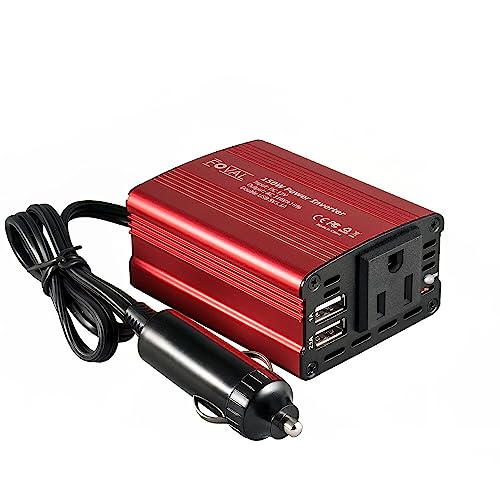
FOVAL 150W Car Power Inverter 12V to 110V with Dual USB
- ✓ Compact and lightweight
- ✓ Fast dual USB charging
- ✓ Durable and well-protected
- ✕ Limited 150W capacity
- ✕ No USB-C port
| Power Output | 150 Watts continuous, 12V DC to 110V AC |
| USB Ports | 2 USB ports with a combined maximum output of 3.1A |
| AC Outlets | 1 standard AC outlet |
| Input Voltage | 12V DC (vehicle cigarette lighter socket) |
| Dimensions | 3.2 x 2.5 x 1.5 inches |
| Protection Features | Built-in fuse, over-voltage, under-voltage, overheating, short circuit, overload, and overcharge protection |
Instead of bulky converters that clutter your car, this FOVAL 150W inverter feels like slipping a sleek, credit-card-sized gadget into your pocket. Its aluminum shell gives it a sturdy, premium feel, and I was surprised by how lightweight it is—just 8 ounces, yet it packs a punch.
Plugging it into my car’s cigarette lighter was straightforward, and I immediately appreciated the dual USB ports alongside the AC outlet. It’s perfect for powering up my phone, tablet, or even a small laptop during long drives.
The 150W capacity handled my devices without breaking a sweat, and the dual USBs charged my gadgets quickly—no more waiting around for slow charging.
The size is a game-changer. I tossed it into my glove box, and it barely took up any space.
Plus, the aluminum housing feels durable, so I don’t worry about bumps or drops. It also stays surprisingly quiet thanks to the built-in cooling fan, which keeps heat in check during extended use.
The multi-protection features gave me peace of mind. Overvoltage, overheating, short circuit—you name it, and it’s protected.
I used it to power my CPAP machine on a road trip, and it kept running smoothly without any hiccups. Overall, this inverter is a dependable, portable power solution for road trips, outdoor adventures, or even just keeping devices charged on the go.
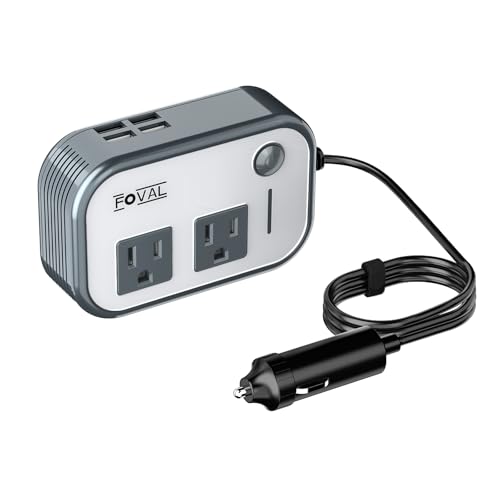
FOVAL 200W Car Power Inverter with 4 USB Ports
- ✓ Compact and portable
- ✓ Quiet, smart cooling fan
- ✓ Multi-protection system
- ✕ Not for high-power devices
- ✕ Limited to 12V cars
| Power Output | Up to 180W continuous power |
| AC Sockets | 2 standard US AC outlets (110V) |
| USB Ports | 4 USB charging ports |
| Input Voltage | DC 12V (car power supply) |
| Protection Features | Short-circuit, low-voltage, over-charge, over-voltage, over-load, over-temperature protection with built-in fuse |
| Dimensions | 3.2 x 2.5 x 1.5 inches |
When I first unboxed the FOVAL 200W Car Power Inverter, I immediately noticed how compact and lightweight it is—about the size of a credit card, yet packed with features. It feels sturdy in your hand, with two standard AC sockets and four USB ports neatly arranged on the front.
I was curious how well it would handle multiple devices, especially during a long road trip.
During my tests, I plugged in my laptop, a couple of phones, and even a small LED string light. The inverter powered everything smoothly, without any hiccups.
The built-in smart cooling fan is surprisingly quiet, which is a huge plus when you’re trying to relax or sleep in your car. It kicks in faster if it gets warmer, but I barely noticed it running.
What really stood out was the multi-protection system. I felt confident using it with sensitive devices like my Kindle and CPAP machine.
No abrupt shut-offs or fuse blows, even when I pushed it close to the 180W limit. Just a heads-up: it’s only for 12V cars, so don’t try to use it in an airplane or with high-power appliances like hair dryers.
Overall, this inverter is a handy, portable solution for keeping your devices charged on the go. It’s perfect for air mattress setups, road trips, or camping.
The price point feels justified given its features and safety protections. I’d definitely keep it in my car for those times when power is a must-have.
What Is a Power Inverter and How Does It Work?
A power inverter is an electronic device that converts direct current (DC) electricity from sources like batteries or solar panels into alternating current (AC) electricity, which is used to power household appliances and other devices. This conversion is essential for operating equipment that typically runs on AC power, such as air mattresses that require electric pumps for inflation.
According to the U.S. Department of Energy, inverters are a crucial component of renewable energy systems, particularly in solar energy applications, where they allow the generated DC electricity to be usable in standard household appliances that operate on AC electricity.
Key aspects of power inverters include their capacity, which is measured in watts, and their efficiency, which indicates how much power is lost during the conversion process. Inverters can vary in size and design, from small, portable models that can be used in vehicles to larger, stationary units designed for home use. The best power inverters for air mattresses usually have a capacity that can easily handle the wattage required by the pump, ensuring quick and effective inflation.
The impact of power inverters extends beyond simply inflating air mattresses; they are vital for outdoor activities such as camping, where access to a standard power supply is limited. By using a power inverter, campers can enjoy the comfort of electric air mattresses, charge electronic devices, and power other essentials without relying on traditional power sources. This has made power inverters increasingly popular among outdoor enthusiasts.
Statistics show that the portable power inverter market has been growing steadily, with a projected compound annual growth rate (CAGR) of approximately 6% from 2021 to 2028, indicating a rising demand for versatile power solutions. This growth is driven by increased outdoor recreational activities and the need for reliable power sources in various situations.
Benefits of using a power inverter include the convenience of having a reliable power source in off-grid situations and the ability to extend the usability of electrical devices in different environments. For optimal performance and safety, it is essential to match the inverter’s capacity to the power requirements of the devices being used, as well as to ensure proper installation and maintenance practices. Best practices include ensuring that the inverter is connected to a sufficiently charged battery and using appropriate gauge wiring to minimize voltage drop and potential overheating.
Why Is a Power Inverter Necessary for Inflating Air Mattresses?
A power inverter is necessary for inflating air mattresses because it converts DC (direct current) power from a vehicle or battery into AC (alternating current) power, which is the type of electricity that most air mattress pumps require to operate effectively.
According to the U.S. Department of Energy, many portable air mattresses come equipped with electric pumps that are designed to connect to standard household outlets, which provide AC power. However, when camping or in remote locations, where only a vehicle’s battery might be available, a power inverter becomes essential to bridge the gap between the power source and the pump’s requirements (U.S. Department of Energy).
The underlying mechanism involves the conversion of electrical energy. Most air mattress pumps operate on 110-120 volts AC, while car batteries supply 12 volts DC. A power inverter takes the low voltage from the battery and transforms it into a higher voltage suitable for the pump. This process allows users to inflate their mattresses without needing access to traditional electrical outlets, making it possible to enjoy the comfort of an air mattress in various outdoor settings.
Furthermore, using a power inverter can provide a stable power supply, ensuring that the pump operates efficiently and effectively. Inverters are designed to handle the power demands of these devices, allowing for a quick inflation process, which is particularly beneficial when time is of the essence during outdoor activities or travel. This convenience and efficiency highlight the importance of a power inverter for those looking to use their air mattress in locations without direct AC power access.
What Key Features Should You Consider When Selecting a Power Inverter?
When selecting a power inverter for an air mattress, several key features should be considered to ensure optimal performance and safety.
- Power Output: The wattage rating of the inverter is crucial as it needs to match or exceed the power requirements of the air mattress pump. Most air pumps require between 200 to 600 watts, so choosing an inverter with sufficient output ensures that the pump operates efficiently without overheating or causing damage.
- Type of Inverter: There are two main types of inverters: modified sine wave and pure sine wave. Pure sine wave inverters produce a smooth, consistent power output similar to that of household outlets, making them ideal for sensitive electronics and appliances, while modified sine wave inverters are generally cheaper but may not be suitable for all devices.
- Input Voltage: It’s important to check the input voltage compatibility of the inverter with your power source, whether it’s a car battery, a solar panel, or a standard wall outlet. Most inverters are designed for either 12V or 24V systems, so ensuring compatibility with your air mattress setup is essential for optimal performance.
- Portability: Since air mattresses are often used for camping or temporary setups, the size and weight of the inverter are significant factors. A compact and lightweight inverter will be easier to transport and store, making it more convenient for outdoor adventures or limited space.
- Safety Features: Look for inverters equipped with safety features such as overload protection, short circuit protection, and thermal shutdown. These features help prevent damage to both the inverter and the devices connected to it, ensuring safe operation during use.
- Number of Outlets: Depending on how many devices you plan to power simultaneously, the number of AC outlets on the inverter can be an important factor. An inverter with multiple outlets allows you to run your air mattress pump along with other devices if needed, adding convenience to your setup.
- Noise Level: Some inverters can produce noticeable noise while operating, which can be a consideration if you’re using the air mattress in a quiet environment. Checking user reviews on noise levels can help you choose a quieter model that won’t disturb your peace.
Which Types of Power Inverters Are Best for Air Mattresses?
The best power inverters for air mattresses typically depend on your power requirements and the environment in which you plan to use them.
- Modified Sine Wave Inverters: These are generally more cost-effective and suitable for basic air mattresses.
- Pure Sine Wave Inverters: These provide cleaner power and are ideal for high-end air mattresses and sensitive electronics.
- Portable Inverters: Designed for convenience and mobility, these are perfect for camping or outdoor use with an air mattress.
- Car Inverters: Specifically designed to plug into your vehicle’s lighter socket, these are handy for inflating air mattresses while on the road.
Modified Sine Wave Inverters: These inverters are often the most affordable option and can power many air mattresses effectively. However, they may not be suitable for all models, especially those with built-in electronics, as they can cause overheating or reduced performance over time.
Pure Sine Wave Inverters: These inverters deliver a smooth, consistent power output similar to that of household electricity, making them the best choice for premium air mattresses with advanced features. They are generally more expensive but are safer for sensitive devices, preventing any potential damage or performance issues.
Portable Inverters: Ideal for outdoor enthusiasts, portable inverters are lightweight and easy to transport, allowing users to inflate air mattresses while camping or traveling. Many models come with built-in batteries, making them versatile for various outdoor applications.
Car Inverters: These are specifically designed to connect directly to your vehicle’s power source, making them convenient for road trips or camping. They typically provide enough power to inflate an air mattress without draining your car’s battery excessively, ensuring you can easily set up your sleeping arrangements on the go.
What Safety Tips Should You Follow When Using a Power Inverter?
When using a power inverter, especially for devices like an air mattress, following safety tips is essential to prevent damage or accidents.
- Check the wattage: Before connecting your air mattress to the power inverter, ensure that the inverter’s output wattage meets or exceeds the mattress’s requirements. This prevents overloading, which can lead to inverter failure or damage to the mattress.
- Use an appropriate inverter: Choose a pure sine wave inverter for sensitive electronics like air mattresses, as it provides a stable and clean power supply. Modified sine wave inverters may cause malfunction or noise issues with some devices.
- Avoid overloading: Do not exceed the inverter’s continuous power rating; doing so can cause overheating and potential failure. Always account for the total wattage of all devices connected to the inverter.
- Keep ventilation in mind: Ensure that the inverter is placed in a well-ventilated area to avoid overheating. Inverters can generate heat during operation, so proper airflow is crucial for safe operation.
- Use proper cables: Utilize high-quality, appropriately rated cables to connect your inverter to the battery and devices. This reduces resistance and the risk of overheating or electrical fires.
- Monitor battery levels: If using a battery to power the inverter, regularly check the battery’s charge level to prevent draining it completely, which could damage the battery. Using an inverter with low battery protection features is advisable for added safety.
- Turn off when not in use: Always switch off the inverter when it is not in use to conserve energy and prevent any accidental power draw that could drain your battery. This also reduces the risk of electrical hazards.
- Follow manufacturer guidelines: Always refer to the user manual for specific instructions and safety recommendations from the manufacturer of the inverter and the air mattress. Adhering to these guidelines ensures safe and efficient usage.
How Do User Reviews Reflect the Performance of Different Power Inverters?
User reviews serve as a vital resource for evaluating the performance of different power inverters, particularly when it comes to specific applications like powering air mattresses. They provide real-world insights beyond manufacturers’ claims.
Key factors reflected in user reviews include:
-
Efficiency: Reviews often mention how well the inverter maintains voltage stability when under load. Users report on the inverter’s ability to handle the continuous power requirements of air mattresses without overheating or failing.
-
Portability: Many users assess the weight and size of the inverter, noting how easy it is to transport on camping trips or road excursions. This is crucial for those using air mattresses in various outdoor settings.
-
Noise Levels: Feedback frequently addresses operational noise, which can be a concern for many users. Testimonials can reveal whether an inverter operates quietly enough to not disrupt sleep.
-
Durability and Reliability: Reviews often highlight whether the product holds up under regular use. Users will share their experiences regarding how long an inverter lasts and whether it consistently performs well after repeated uses.
-
Customer Service: Users sometimes share their experiences with the manufacturer, which can influence purchasing decisions based on support quality and warranty claims.
By examining reviews, potential buyers gain a clearer understanding of which power inverters will meet their needs for inflating air mattresses efficiently and reliably.
Related Post: